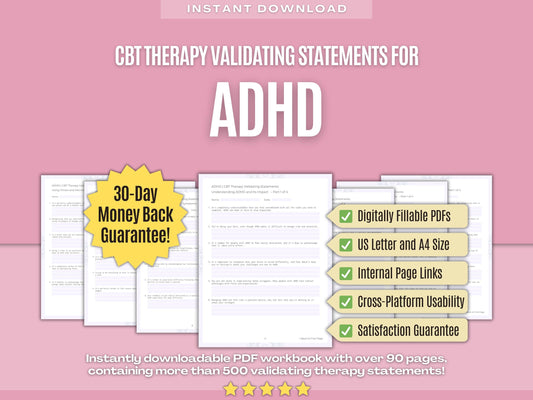
Elevate Your Therapy and Guide Your Clients to Inner Healing with Our Stress and Anxiety Validating Therapy Statements! ✨
1. Beginning of Therapy
- Starting therapy can feel daunting, but you've already shown bravery by taking this step.
- It's completely normal to feel a mix of emotions as we embark on this therapeutic journey together.
- The fact that you're here today shows your commitment to finding relief from stress and anxiety.
- Your willingness to engage in therapy speaks volumes about your resilience and determination.
- I want to assure you that this is a safe space where you can express yourself freely.
- The courage it takes to confront stress and anxiety head-on is something to be admired.
- Your well-being is a priority, and I'm committed to helping you achieve a sense of peace.
- I want you to know that there's no judgment here; you can be yourself without fear.
- Your experiences are unique to you, and we'll tailor our approach to meet your specific needs.
- Your journey toward healing is a process, and I'm here to offer guidance and support.
- It's important to recognize and honor your emotions, even the difficult ones.
2. Stress and Anxiety Psychoeducation
- Understanding stress and anxiety is the first step toward managing them effectively.
- Your experiences of stress and anxiety are valid, and it's okay to seek help in managing them.
- Anxiety often stems from a perceived threat, even if it's not immediately apparent.
- Understanding the role of neurotransmitters like serotonin and dopamine in anxiety can provide insight into treatment approaches.
- It's common for anxiety to trigger negative thought patterns, but these can be challenged and reframed.
- Cognitive-behavioral therapy (CBT) can be effective in identifying and changing maladaptive thought patterns.
- Understanding the fight-or-flight response can shed light on why certain situations trigger anxiety.
- Journaling can be a valuable tool for tracking triggers and exploring underlying emotions related to stress and anxiety.
- It's important to recognize when professional help is needed to address severe or persistent anxiety.
- Understanding the cycle of stress and anxiety can empower you to intervene and break the pattern.
- Practicing assertiveness and setting boundaries can help manage stress related to interpersonal relationships.
3. Mindfulness-Based Interventions
- Mindfulness is about being fully present in the moment, without judgment or attachment.
- Mindfulness can help you cultivate a greater awareness of your thoughts, feelings, and bodily sensations.
- Mindfulness teaches us to observe our thoughts and emotions with curiosity and compassion.
- Mindfulness-based interventions can be effective in breaking the cycle of rumination and worry.
- Bringing awareness to your breath can serve as an anchor during times of stress, helping to ground you in the present moment.
- Body scan exercises can help you tune into physical sensations and release tension held in the body.
- Mindfulness-based stress reduction (MBSR) programs have been shown to effectively reduce symptoms of anxiety and depression.
- Mindful walking exercises can help you connect with the sensations of movement and ground yourself in the present moment.
- Mindfulness allows us to let go of the past and future, focusing instead on the richness of the present moment.
- Practicing mindfulness can help you develop a deeper understanding of yourself and your patterns of thought and behavior.
- Mindfulness invites us to cultivate an attitude of gratitude, appreciating the small moments of joy and beauty in everyday life.
4. Dialectical Behavior Therapy (DBT) for Stress and Anxiety
- Dialectical Behavior Therapy (DBT) offers a comprehensive approach to managing stress and anxiety by integrating elements of mindfulness, distress tolerance, emotion regulation, and interpersonal effectiveness.
- DBT recognizes that stress and anxiety often stem from difficulties in regulating emotions and interpersonal relationships.
- You have the capacity to cultivate greater emotional resilience and balance through DBT skills training.
- By practicing mindfulness techniques, you can learn to respond to stress and anxiety with greater clarity and intention.
- You have the ability to build a toolkit of coping skills that you can draw upon during times of stress and distress.
- Through emotion regulation techniques, you can learn to reduce the intensity of negative emotions and increase positive emotional experiences.
- You have the power to cultivate more satisfying and fulfilling connections with others through DBT.
- By incorporating dialectics into our thinking, we can embrace the complexities of life and find synthesis between seemingly contradictory perspectives.
- You are not defined by your emotions; through DBT, you can learn to respond to them in ways that align with your values and goals.
- DBT provides a structured framework for developing resilience and coping skills that can be applied across various areas of your life.
- DBT emphasizes the importance of self-compassion and acceptance, recognizing that we are all doing the best we can with the resources we have.
5. Interpersonal Therapy (IPT) for Stress and Anxiety
- It's understandable that you're feeling overwhelmed by these stressors; anyone in your position would likely feel the same.
- I can see how challenging this situation is for you, and I'm here to support you in finding coping strategies that work for you.
- Your feelings are important, and it's okay to express them openly and honestly here.
- It's okay to take a step back and prioritize your well-being amidst these stressful relationships.
- It sounds like you're carrying a heavy burden, and I'm here to help lighten that load.
- Your feelings of fear and worry are valid responses to these circumstances.
- It sounds like you're feeling unsupported in these relationships, and that's a valid concern.
- Your experiences matter, and I'm here to validate and support you through them.
- Your emotions are a natural response to these interpersonal stressors; let's explore how to navigate them together.
- Your feelings of frustration are valid, and it's important to address them constructively.
- Your experiences of stress and anxiety are valid, and I'm here to help you find relief.
6. Emotion-Focused Therapy (EFT) for Stress and Anxiety
- Your emotions are valid, and it's important to acknowledge and honor them as we delve into your stress and anxiety.
- Your feelings of stress and anxiety are important signals from your inner self, and I'm here to help you decipher their messages.
- Your emotional experiences are unique to you, and I'm here to validate and support you through them.
- Your emotions are not something to be dismissed or suppressed; they hold valuable insights into your inner world.
- Your emotional well-being is a priority, and I'm here to help you cultivate resilience and coping strategies.
- Your feelings of fear and worry are natural responses to stressors; I'm here to help you find ways to soothe and regulate them.
- Your emotional experiences may be complex, but together, we can untangle and make sense of them.
- Your emotions hold valuable clues about your needs and desires; I'm here to help you listen to and honor them.
- Your emotional responses are valid, and it's important to give yourself permission to feel them fully.
- Your emotional experiences are an integral part of your journey towards healing; I'm here to support you every step of the way.
- Your emotional authenticity is a strength, and I'm here to help you harness it as we address your stress and anxiety.
7. Psychodynamic Therapy for Stress and Anxiety
- Your experiences are important, and I'm here to help you explore how they may be contributing to your stress and anxiety.
- Your emotions are valid, and it's important to acknowledge and understand them as we delve into your stress and anxiety.
- Your relationships, past and present, may hold valuable insights into the roots of your stress and anxiety; I'm here to help you explore and process them.
- Your early childhood experiences may be shaping your perceptions and behaviors in ways that contribute to your stress and anxiety; I'm here to help you understand and heal from them.
- Your coping mechanisms may be rooted in unconscious patterns; I'm here to help you identify and change those that are no longer serving you.
- Your dreams and fantasies may offer valuable insights into your subconscious mind; I'm here to help you interpret and understand them.
- Your sense of identity and self-worth may be influenced by unconscious beliefs and conflicts; I'm here to help you challenge and reshape them.
- Your defenses may be protecting you from painful emotions, but they may also be hindering your ability to fully engage in the therapeutic process; I'm here to help you navigate through them.
- Your unconscious mind holds valuable wisdom and resources for healing; I'm here to help you access and utilize them.
- Your stress and anxiety may be rooted in unconscious fears or desires; I'm here to help you explore and address them.
- Your capacity for growth and change is limitless, and I'm here to support you in realizing your full potential.
8. Music Therapy for Stress and Anxiety
- It's completely understandable that you find solace in music during times of stress.
- Music has this remarkable ability to speak to our emotions in a way that words often can't.
- Your preference for particular genres or artists is unique to you, and that's perfectly okay.
- The rhythm and harmony you find in music can offer a sense of stability when everything else feels uncertain.
- I appreciate your willingness to explore how music can be integrated into your stress management routine.
- Let's delve deeper into how we can harness the therapeutic benefits of music to alleviate your anxiety.
- It's impressive how you've identified specific songs or playlists that help you relax and unwind.
- Your connection to music seems to transcend mere enjoyment; it's a vital aspect of your emotional well-being.
- Your insights into the nuances of different musical compositions reveal a deep appreciation for the art form.
- Your openness to experimenting with different musical techniques reflects a proactive approach to managing your anxiety.
- Your description of music as a companion during challenging times resonates with many others who find solace in its melodies.
9. Therapy Session Wrap-Up
- It's been truly insightful to explore your thoughts and emotions together in today's session.
- I appreciate your openness and honesty during our conversation—it's essential for our work together.
- It's clear that you've put a lot of effort into implementing the strategies we've discussed, and it's paying off.
- Remember to celebrate even the smallest victories—they're significant milestones on the path to healing.
- Your courage in facing difficult emotions head-on is commendable and will serve you well in the long run.
- Your willingness to challenge negative thought patterns and explore new perspectives is key to overcoming obstacles.
- Your commitment to self-care and prioritizing your mental health is a testament to your strength and resilience.
- Your insights into your own triggers and coping mechanisms are invaluable tools for navigating future challenges.
- Remember that progress isn't always linear; it's normal to experience ups and downs along the way.
- I encourage you to carry the insights and strategies we've discussed today with you as you go about your week.
- It's empowering to see you take ownership of your well-being and actively engage in the therapeutic process.
10. Concluding Therapy Meeting
- It's been an honor and privilege to accompany you on this journey towards healing and growth.
- Your courage and resilience throughout this therapeutic process have been nothing short of inspiring.
- Your commitment to your own well-being and personal growth has been evident in every session we've had.
- It's okay to feel a mix of emotions as we wrap up our therapeutic work—it's all part of the process.
- I want to acknowledge the strength it takes to embark on a journey of self-discovery and healing.
- Your dedication to investing in your mental health sets a powerful example for others on a similar path.
- Remember that you are not alone on this journey—there is support available to you whenever you need it.
- I'm confident that you have the tools and resources within you to navigate any challenges that may arise in the future.
- It's been an honor to witness your transformation and growth throughout our time together.
- Take a moment to acknowledge and appreciate the hard work and dedication you've put into your own personal growth.
- Trust in your own resilience and inner strength as you continue moving forward on your path.
We hope that our validating therapy statements for Stress and Anxiety therapy will help you to elevate your therapy practice and guide your clients to inner healing! Do you need more validating therapy statements for Stress and Anxiety therapy? Find them all in our Digital Workbook! Or do you have any questions or suggestions for us? Please feel free to contact us at any time!